 Gleez
Gleez
In the evolving landscape of Web3, where decentralization and user sovereignty reign supreme, Nostr emerges as a game-changer for social media and beyond. Short for “Notes and Other Stuff Transmitted by Relays,” Nostr isn’t just another app—it’s a simple, robust protocol designed to enable censorship-resistant, privacy-focused communication on a global scale. Backed by figures like Jack Dorsey and integrated with Bitcoin’s Lightning Network, Nostr flips the script on centralized platforms like Twitter (now X) or Facebook.
Whether you’re a user tired of data silos, a developer seeking permissionless innovation, or a privacy advocate, Nostr offers a fresh paradigm. Let’s dive into how it works, why it excels at protecting privacy, its key components (clients, relays, and protocol), and how you can build apps on it.
What is Nostr and Its Web3 Connection? 🌐🔗
Nostr is an open-source protocol that facilitates decentralized social networking, messaging, and data sharing. Unlike traditional social media giants that hoard your data on central servers, Nostr distributes it across a network of independent relays. This aligns perfectly with Web3 principles: user-owned identities via cryptographic keys, no single point of failure, and seamless integration with blockchain tech like Bitcoin for micropayments (e.g., “zaps” for tipping content).
At its core, Nostr treats everything as “events”—signed JSON objects that can represent posts, follows, likes, or even custom data. These events are transmitted via WebSockets, making the system lightweight and scalable. Since its inception around 2021-2022, Nostr has gained traction in crypto communities for its resistance to censorship and emphasis on freedom.
How Nostr Works: The Basics ⚙️📡
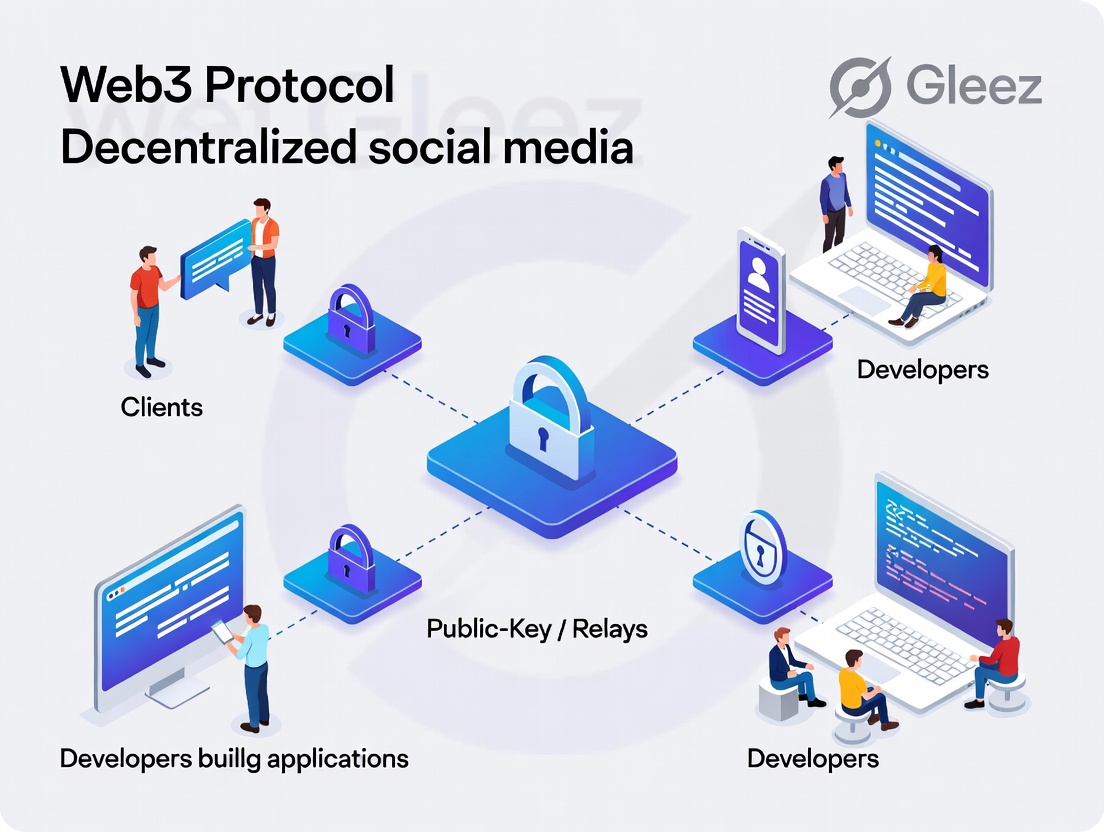
Nostr’s architecture is elegantly simple: it’s built around clients and relays communicating over a standardized protocol.
-
Events as the Building Blocks: Everything starts with an “event.” This is a piece of data (like a note, profile update, or reaction) packaged in JSON format. Each event includes:
- A unique ID.
- The content.
- Timestamps.
- References to other events (e.g., replies or quotes).
- A cryptographic signature from the user’s private key, ensuring authenticity and non-repudiation.
-
The Flow of Data:
- A user creates an event in their client app.
- The client signs it with the private key and sends it to one or more relays.
- Relays store the event and forward it to subscribed clients.
- Other users’ clients query relays for events, filtering by follows, topics, or time.
- No relay talks to another—clients handle aggregation, pulling data from multiple sources for a complete feed.
This relay-client model ensures resilience: if one relay goes down or censors content, users switch seamlessly without losing their identity or history.
How Nostr Protects Privacy 🛡️🔒
Privacy is baked into Nostr’s DNA, addressing the pitfalls of centralized platforms where data breaches and surveillance are rampant.
-
Public-Key Cryptography: Users are identified by public keys (npub…), not emails or usernames. Your private key stays on your device, used only for signing events. No passwords to hack, no central database of user info.
-
No Central Authority: Relays don’t own your data—you choose which ones to trust. You can run your own relay for ultimate control. This decentralizes tracking; no single entity sees your full activity graph.
-
Censorship Resistance: If a relay bans your content, broadcast to others. Clients can filter spam or unwanted events locally, empowering users over algorithms.
-
Minimal Data Exposure: Events are public by design (for social features), but private messaging exists via encrypted events (NIP-04). Integrations like Lightning Network for payments keep transactions pseudonymous.
-
User Control: Switch clients or relays anytime; your key pair is portable. No vendor lock-in means better privacy hygiene.
In a Web3 context, this setup prevents the “honeypot” risks of centralized Web2 social media, where governments or advertisers exploit user data.
Nostr Clients, Relays, and Protocol Breakdown 📱🖥️📜
-
Clients: These are the user-facing apps, like Damus (iOS), Amethyst (Android), or web-based ones such as Snort or Iris. Clients are “smart”—they manage connections, render feeds, and handle features like search or notifications. Developers compete by building better UIs, adding extras like media support or integrations.
-
Relays: “Dumb” servers that simply receive, store, and serve events. Anyone can run one using open-source software (e.g., nostr-rs-relay in Rust with SQLite). They use WebSockets for real-time comms and support filters for efficient querying. Economic models include paid relays for premium storage or anti-spam.
-
Protocol (NIPs): Nostr Implementation Possibilities (NIPs) define extensions. The base protocol (NIP-01) covers events and relays. Others add features:
- NIP-05: Verifiable identities (e.g., username@domain).
- NIP-19: Human-readable keys.
- NIP-36: Sensitive content handling.
- NIP-57: Zaps for Lightning tips.
The protocol’s simplicity (just JSON over WebSockets) makes it extensible without forking.
How Developers Can Build Apps on Nostr 🛠️💻
Nostr’s low barrier to entry fuels innovation—anyone can build without permission.
-
Get Started: Study the docs at nostr.com or GitHub (nostr-protocol/nips). Use libraries like nostr-tools (JS), nostr-sdk (Rust), or equivalents in Python/Go.
-
Building a Client:
- Connect to relays via WebSockets.
- Generate/sign events with crypto libs (e.g., secp256k1 for signatures).
- Handle subscriptions (REQ messages) to fetch real-time updates.
- Add UI for posting, following, and displaying feeds.
-
Custom Apps: Beyond social media, build:
- Decentralized marketplaces (events as listings).
- Blogs or newsletters (long-form via NIP-23).
- Games or DAOs with event-based voting.
- Integrate with Web3 wallets for auth/payments.
-
Best Practices:
- Support multiple relays for redundancy.
- Implement NIPs for interoperability.
- Use tools like relays.dev for testing.
- Monetize via zaps or premium features.
Nostr’s ecosystem is booming, with hackathons and grants encouraging devs. As Web3 matures, expect more hybrid apps blending Nostr with blockchains.
The Future of Nostr: A Privacy-First Web3 Staple? 🔮
Nostr isn’t perfect—scalability challenges and relay economics persist—but its design prioritizes users over profits. In a world of increasing digital authoritarianism, it offers a beacon for free expression. If you’re in Web3, dip your toes: grab a client, generate a key pair, and join the conversation.